Your new weekly food waste collection

Find out more about how the new collection works

Please don't start using your caddies until the start of the new service in June 2026.

Your new caddies!

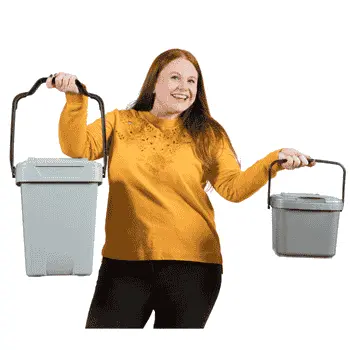
You should receive your two food waste caddies between February and May. The smaller caddy is to store your food waste inside the home. The food waste can then be transferred to the larger caddy, kept outside and used for collection when the new service starts in June 2026.

Woman in yellow top holding two food waste caddies

What can you put in your caddies?

How it works

Food waste caddy with liner in and number 1 in corner

Step 1

Whilst you don’t have to line the caddy, doing so will keep the caddy cleaner and will be easier to transfer the food waste to the larger caddy. One free roll of compostable liners is provided with the caddy and replacements can be purchased from supermarkets. 

Food caddy with banana peel in.

Step 2

Place your food waste into the small caddy inside your home.

Hand putting food waste liner full of food into caddy with number 3 in corner.

Step 3

Tie a knot in the bag and transfer to the larger caddy outside. Don’t let the caddy get too full!

Food waste caddy with red arrow showing handle is locked and number 4 in corner.

Step 4

On the larger caddy, pull the handle forward until you hear a click to keep the lid securely shut.

What happens to it?

Each year in Suffolk, we throw over 50,000 tonnes of food into our rubbish bins! This is not only the leftovers on our plates, but lots of other things such as veg peeling, fruit cores, meat and dairy products, tea bags and food that has gone out of date.

Did you know the average family of four could save around £1000 a year if they used up all the food they buy? We know it’s very difficult to stop all waste, so that’s why we are introducing a new food waste collection.

This food recycling will be collected by your Council’s recycling and waste crews and delivered to a facility in Suffolk where two products are made:

  • Biogas is used as a renewable energy source to generate heat, electricity, and fuel by capturing and burning methane produced from organic waste, reducing our need for fossil fuels.
  • Biofertiliser is a nutrient rich fertiliser which will be spread on farmers’ fields across East Anglia.

The food waste recycling service is one of several changes being made to recycling and waste services across Suffolk in 2026, designed to make it easier for everyone to recycle more.